Volatile Organic Compounds (VOCs), Neurodegeneration, and Parkinson’s Disease
 wildex
Abstract
Parkinson’s disease (PD) is a progressive neurodegenerative disorder characterized by selective loss of dopaminergic neurons in the substantia nigra and accumulation of α-synuclein pathology. While genetic susceptibility accounts for a subset of cases, increasing evidence implicates environmental toxicants — including volatile organic compounds (VOCs) — as contributors to disease risk. This review summarizes epidemiological and mechanistic evidence linking VOC exposure to Parkinson’s disease and argues for the importance of environmental monitoring in educational and community settings as a precautionary public health strategy.
1. Introduction
Parkinson’s disease affects more than 10 million individuals globally and represents one of the fastest growing neurological disorders. Although monogenic variants exist, most cases are idiopathic and likely result from complex gene–environment interactions.
Volatile Organic Compounds (VOCs) are carbon-based chemicals that readily vaporize at ambient temperature. They include:
- Trichloroethylene (TCE)
- Benzene
- Toluene
- Xylene
- Styrene
- Formaldehyde
These compounds are widely present in:
- Industrial degreasing agents
- Fuel combustion emissions
- Indoor building materials
- Cleaning agents
- Paints and adhesives
While acute toxicity is well characterized, growing research suggests that chronic, low-level exposure may have long-term neurological implications.
2. Epidemiological Evidence Linking VOCs and Parkinson’s Disease
2.1 Trichloroethylene (TCE)
Among VOCs, trichloroethylene has been most strongly associated with Parkinson’s disease.
Goldman et al. (2012) reported that occupational exposure to TCE was significantly associated with increased PD risk in twin studies [1]. More recently, Ascherio et al. (2023) described TCE as a potential “hidden driver” of Parkinson’s disease due to its persistence in groundwater and indoor air environments [2].
2.2 Solvent Exposure and Neurodegenerative Risk
Meta-analyses indicate that chronic exposure to organic solvents correlates with elevated PD incidence [3]. Experimental animal models demonstrate that TCE exposure selectively damages dopaminergic neurons in the substantia nigra, replicating Parkinsonian pathology [4].
2.3 Mixed Urban Air Pollutants
Urban air contains complex mixtures of particulate matter and VOCs. Long-term exposure to traffic-related pollutants has been associated with increased neurodegenerative disease risk, including Parkinson’s disease [5].
Although VOCs are often studied in occupational contexts, indoor environmental exposure is increasingly relevant, particularly in schools and residential spaces.
3. Mechanistic Pathways
Several biological mechanisms support plausibility:
3.1 Mitochondrial Dysfunction
Chlorinated solvents such as TCE inhibit mitochondrial complex I, a pathway central to Parkinson’s pathogenesis [6].
3.2 Oxidative Stress
VOCs increase reactive oxygen species (ROS) production, leading to oxidative neuronal injury [7].
3.3 Neuroinflammation
Chronic toxicant exposure activates microglia, sustaining inflammatory cascades implicated in dopaminergic degeneration [8].
3.4 Protein Misfolding
Environmental toxicants may promote α-synuclein aggregation and proteostasis disruption [9].
These mechanisms align with known pathological features of Parkinson’s disease.
4. Indoor Air: The Emerging Frontier
Indoor air can contain measurable VOC concentrations from:
- Synthetic furnishings
- Cleaning chemicals
- Construction materials
- Poor ventilation
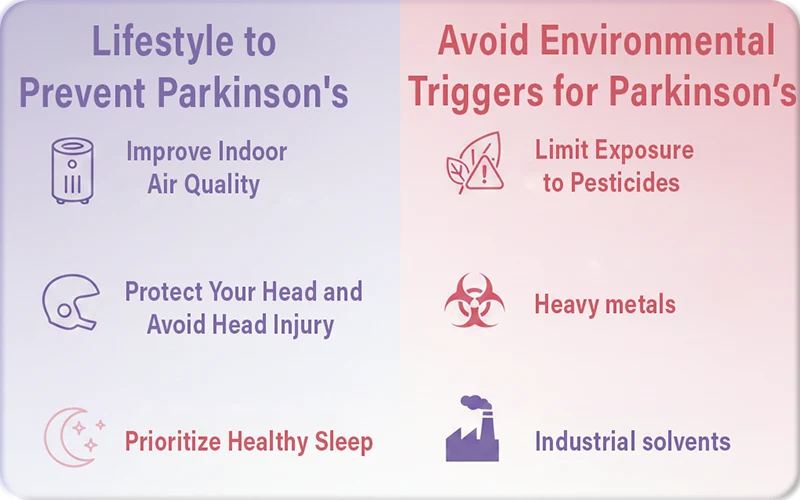
Children and adolescents may spend 6–8 hours daily in classrooms, making indoor air quality a long-term exposure concern.
While current exposure levels in schools are typically below acute safety limits, neurodegenerative diseases develop over decades. Therefore, even modest chronic exposures warrant precautionary consideration.
5. Environmental Monitoring as a Preventive Strategy
In the context of environmental neurology, monitoring does not imply established causation but reflects a precautionary principle.
Systematic monitoring of indoor VOC levels can:
- Identify elevated exposure environments
- Improve ventilation strategies
- Encourage safer material choices
- Increase environmental health literacy
- Support long-term epidemiological research
Importantly, environmental sensing technologies now allow real-time detection of total VOC levels (TVOC), enabling data-driven awareness in educational settings.
Integrating environmental sensing platforms within schools serves dual purposes:
- Health-oriented surveillance
- Scientific education and environmental literacy
Such systems allow students and educators to observe how VOC levels fluctuate in response to cleaning products, occupancy density, ventilation changes, or material off-gassing.
By transforming abstract environmental toxicology into measurable classroom data, monitoring becomes both a preventive and educational intervention.
6. Educational Institutions as Environmental Laboratories
Schools occupy a unique position in environmental health ecosystems. They are:
- High-occupancy indoor environments
- Long-duration exposure settings
- Centers of scientific learning
Introducing structured environmental monitoring — including VOC measurement alongside temperature, humidity, and air quality parameters — encourages:
- Data-based inquiry
- Awareness of indoor air quality
- Preventive environmental practices
From a public health perspective, early environmental literacy may influence lifelong exposure behaviors.
7. Conclusion
The evidence linking VOC exposure and Parkinson’s disease continues to evolve. While definitive causal relationships require further longitudinal research, mechanistic plausibility and epidemiological associations justify precautionary monitoring.
Neurodegenerative diseases develop slowly, often decades after exposure. Therefore, early identification and reduction of environmental toxicants represent a rational risk-mitigation strategy.
Environmental sensing in educational and community settings is not merely technological innovation — it reflects a shift toward proactive environmental health awareness.
In the broader context of neurodegenerative disease prevention, monitoring VOC exposure may represent a small but meaningful step toward long-term neurological resilience.
References
- Goldman SM, et al. Solvent exposures and Parkinson disease risk in twins. Ann Neurol. 2012;71(6):776–784.
- Ascherio A, et al. Trichloroethylene and Parkinson’s disease: A call for action. J Parkinsons Dis. 2023;13(3):347–355.
- Pezzoli G, Cereda E. Exposure to pesticides or solvents and risk of Parkinson disease. Neurology. 2013;80(22):2035–2041.
- Gash DM, et al. Trichloroethylene: Parkinsonism and complex I mitochondrial neurotoxicity. Ann Neurol. 2008;63(2):184–192.
- Ritz B, et al. Air pollution and Parkinson’s disease. Environ Health Perspect. 2016;124(3):351–356.
- Schapira AHV. Mitochondrial dysfunction in Parkinson’s disease. Cell Death Differ. 2007;14(7):1261–1266.
- Dias V, et al. Oxidative stress in Parkinson’s disease. J Parkinsons Dis. 2013;3(4):461–491.
- Hirsch EC, Hunot S. Neuroinflammation in Parkinson’s disease. Lancet Neurol. 2009;8(4):382–397.
- Cannon JR, Greenamyre JT. Neurotoxic models of Parkinson’s disease. Cold Spring Harb Perspect Med. 2013;3(9):a009787.